Bulk beverage supply in Europe is not simply a question of finding the lowest price per case. A commercially usable offer must connect the correct product version, case and pallet configuration, remaining shelf life, tax treatment, delivery responsibility and destination requirements.
This guide is written for wholesalers, distributors, importers, retail groups, vending operators and other professional buyers comparing pallet-scale beverage offers. It explains the information that should be agreed before payment, the records that support traceability, and the cost items that determine whether an apparently attractive quotation is commercially workable.
Choose the Order Structure Before Comparing Prices
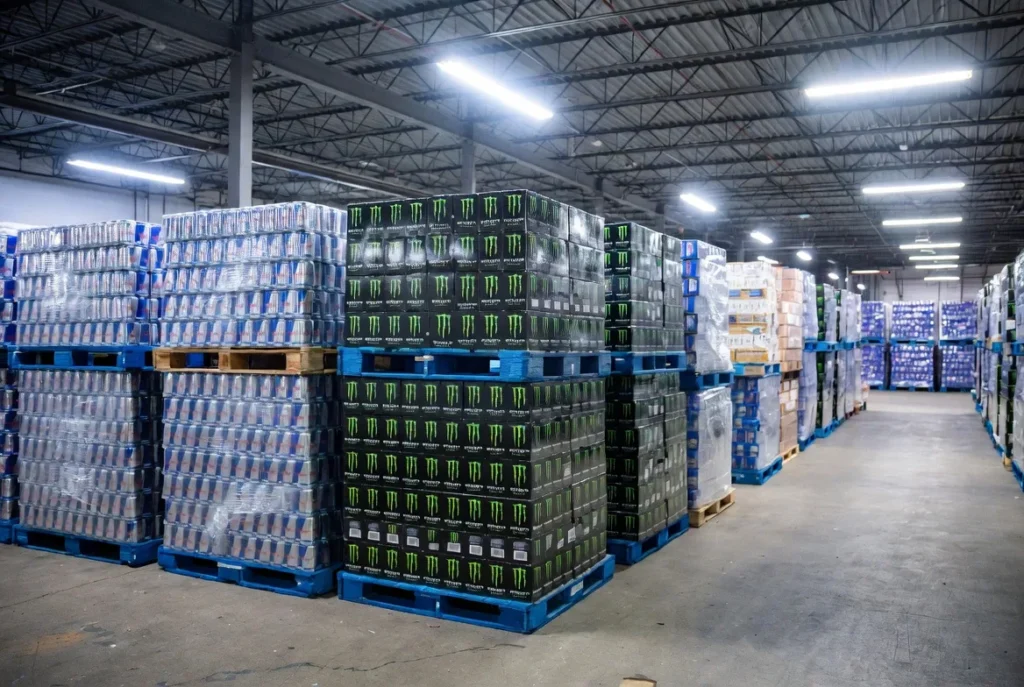
“Bulk” can describe several different buying formats. Two quotations are not comparable when one covers full factory pallets and another covers mixed cases, or when one price includes transport and the other is collection-only. The order structure should therefore be defined before the supplier calculates a price.
| Order format | Typical use | Points to confirm |
|---|---|---|
| Mixed pallet | Range testing, vending routes and smaller multi-SKU distribution. | Eligible products, sealed-case mixing, minimum cases per SKU and load stability. |
| Full product pallet | Established demand for one product or market version. | Cases per pallet, units per case, pallet type, gross weight and stacking rules. |
| Multi-pallet order | Regional wholesalers balancing several brands or formats. | Per-SKU allocation, whether pallets are full or mixed, and one consolidated delivery plan. |
| Full truckload | High-throughput distribution and recurring replenishment. | Loading plan, vehicle weight limits, pallet exchange, delivery slot and unloading capacity. |
| Container shipment | Non-EU or long-distance export programmes. | Container type, port, loading method, importer, customs scope and destination documents. |
For energy drinks specifically, use WOOVE's bulk energy drinks buying guide. Buyers planning smaller multi-SKU assortments can also review the mixed energy drink pallet process. Those pages own the product-specific intent; this article remains a broader procurement framework.
Information a Buyer Should Provide Before Requesting a Quotation
Incomplete enquiries produce conditional prices and unnecessary follow-up. A supplier cannot responsibly confirm freight, product suitability or final minimums from a message that only asks for “the best pallet price.” A quotation-ready request should identify the buyer, the goods and the receiving conditions.
Company and commercial details
- Legal company name and business type
- Company website and business email
- VAT or registration number
- Contact name, telephone and WhatsApp
- Importer-of-record details for applicable routes
Brands, formats and quantities
- Brand, product and preferred variants
- Can or bottle size and case format
- Number of pallets or container type
- Mixed or full product pallets
- Minimum acceptable remaining BBD
Delivery and warehouse information
- Delivery country, city and postcode
- Complete commercial delivery address
- Warehouse receiving hours
- Loading dock or tail-lift requirement
- Required delivery date or receiving window
Terms and repeat demand
- Collection or requested delivery term
- Named delivery place or destination port
- Expected reorder frequency
- Any label, barcode or document requirement
- Who manages customs where applicable
WOOVE order threshold: eligible European enquiries can begin from two pallets. The final minimum depends on product allocation, brand or variant, case format, mix, pallet stability, destination and route. A two-pallet starting point is not an automatic promise that every SKU can be mixed in every configuration.
Compare Landed Cost, Not Only the Case Price
A low ex-warehouse price can become the more expensive option once transport, non-returnable pallets, destination charges or unsuitable packaging are considered. Buyers should request a quotation that separates product value from the logistical and fiscal components.
Commercial price components
Confirm the currency, case price, units per case, cases per pallet, pallet price, quantity tier, quotation validity and whether deposits or reusable pallet charges are excluded.
Delivery price components
Confirm the named place, freight inclusion, fuel or route surcharge, insurance, appointment charges, tail-lift service, unloading and any customs or port costs.
For intra-EU B2B transactions, the parties should confirm their VAT status and invoice treatment rather than assuming that every cross-border sale is automatically zero-rated. The European Commission's VIES service can be used to check whether a business is registered for cross-border trade within the EU. Tax treatment should be confirmed for the actual transaction and parties.
Product Version, Labels, Batch and BBD Checks
A genuine branded product is not automatically ready for retail in every European destination. Market versions may differ in language, responsible food-business-operator information, barcode, deposit markings, nutrition presentation or warnings. These details should be checked against the intended destination before the order is accepted.
Product-version record
- Exact commercial product name
- Can or bottle size and case configuration
- Label language and market version
- EAN or barcode when required
- Nutrition, ingredients and applicable warnings
Batch and shelf-life record
- Batch or lot identification where available
- Exact best-before date for allocated stock
- Remaining BBD at the agreed reference point
- Cases per pallet and allocated quantity
- Condition check before release
EU food-information rules establish responsibilities for mandatory information on prepacked foods. Mandatory information must also appear in a language easily understood by consumers in the Member State where the product is marketed. Buyers can consult the European Commission's guidance on mandatory food information and language and presentation requirements.
Traceability is equally important. EU General Food Law requires food business operators to identify the businesses from which food was supplied and those to which it was supplied. The official text is available in Regulation (EC) No 178/2002. For a wholesale transaction, product description, batch information, quantities and counterparties should therefore remain connected across the quotation, invoice, packing list and warehouse records.
BBD wording matters: do not rely on a generic shelf-life promise for an entire brand. The exact allocated batch and best-before date confirmed in the quotation or commercial documents should take priority. Allocation remains subject to warehouse verification before dispatch.
Delivery Terms Must Name the Place and Divide Responsibility
“Delivered Europe” is not a complete commercial term. A useful quotation states the applicable Incoterm, the version of the rules and the precise named place. It should also clarify loading, unloading, insurance, customs, duties, taxes and the point at which risk transfers.
| Commercial arrangement | What the buyer should verify |
|---|---|
| Collection / seller's facility | Loading point, collection window, vehicle requirements, risk transfer and export responsibility. |
| DAP named place | Seller-arranged transport to the named destination; buyer normally manages unloading and import formalities where applicable. |
| DDP named place | Seller assumes extensive import-clearance, duty and tax responsibilities. Availability depends on whether the seller can legally perform those obligations in the destination. |
| Export port or container route | Correct port term, container type, customs scope, origin documents, destination agent and demurrage responsibility. |
The ICC Incoterms® 2020 rules define how costs, delivery obligations and risk are allocated. They do not determine product ownership, payment timing or every tax consequence; those points belong in the quotation, sales contract or invoice terms.
WOOVE may review collection, DAP, DDP or other delivery arrangements depending on the destination, product, order structure and transaction requirements. No term is automatic. Preparation time and estimated transit time are confirmed separately after stock, postcode, pallet quantity, receiving conditions and carrier availability have been reviewed. The shipping and logistics page explains the information needed for route planning.
How to Verify a Bulk Beverage Supplier
Professional due diligence is more useful than badges or broad statements such as “verified,” “official” or “EU certified.” Buyers should ask for evidence that can be matched to the transaction.
Company and payment checks
- Verify the legal entity and registration number
- Validate VAT status where relevant
- Confirm the invoice issuer before payment
- Investigate unexplained bank-account changes
- Use company-domain contact details
Product and warehouse checks
- Request current product and label photographs
- Confirm case and pallet configuration
- Obtain allocated batch and BBD information
- Ask how damage and quantity checks are recorded
- Match stock documents to the written quotation
Quotation checks
- Product version and destination suitability
- Quantity, currency and price validity
- Named Incoterm place and included costs
- Preparation and estimated transit periods
- Claim, shortage and damage procedure
Documentation checks
- Proforma and commercial invoice
- Packing or pallet list
- Transport document for the selected route
- Export declaration where applicable
- Origin or other documents only where required
WOOVE's company presentation and fulfilment arrangement are explained on the About WOOVE page. Orders are supplied by LIMITED LIABILITY COMPANY WOOVE, registration number 46329225, registered in Kharkiv, Ukraine. European fulfilment and dispatch coordination is handled through Weilimdorf, Germany. Germany is the fulfilment location, not the registered office.
A Controlled B2B Beverage Ordering Process
A useful ordering process creates a written trail from the first requirement to the dispatched goods. It should not depend on vague availability messages or verbal delivery promises.
- Submit a complete business requirement. Identify the company, destination, products, pallet quantity, required date and requested delivery arrangement.
- Review product and route feasibility. Stock allocation, product version, pallet structure and receiving conditions are checked.
- Receive a written quotation. The offer should state products, quantities, currency, BBD information, freight scope, Incoterm and validity.
- Verify the commercial details. The buyer confirms company information, VAT status where applicable, destination and any label or document requirement.
- Approve the proforma invoice. Product, amount, beneficiary and transaction terms should match the accepted quotation.
- Prepare and inspect the allocation. Quantity, condition, batch/BBD and pallet build are checked before release.
- Dispatch with applicable documents. Shipment and transport details are issued for the agreed route.
Professional buyers can compare the available energy-drink range through the wholesale product hub. Distribution businesses should also review distributor and importer supply, while destination availability is summarized on Markets We Supply.
Bulk Beverage Supply in Europe: Buyer Questions
What is the normal minimum order for WOOVE European enquiries?
Eligible European orders can begin from two pallets. Final minimums depend on the brand or product, variant, case format, stock allocation, requested mix, pallet stability, destination and route.
Can different products be combined on one pallet?
Selected mixed pallets may be prepared using factory-sealed cases. Eligibility, the minimum number of cases per SKU and the final loading pattern depend on current stock and transport stability. Loose-can mixing should not be assumed.
How is the remaining best-before period confirmed?
The exact batch and best-before date for allocated stock should be confirmed in the quotation or commercial documents. That written allocation takes priority over a general shelf-life range shown elsewhere.
Does DDP automatically apply to every European destination?
No. DDP creates significant customs and tax obligations for the seller and may not be legally or operationally available for every destination. Collection, DAP, DDP or another arrangement must be reviewed and confirmed in writing for the specific transaction.
How long does pallet delivery take?
There is no responsible Europe-wide fixed transit promise. Preparation time and estimated transit time depend on allocated stock, delivery postcode, pallet quantity, route, receiving requirements and carrier availability. Both periods should be stated separately in the quotation.
Which documents may accompany a wholesale beverage shipment?
Depending on the route and transaction, the document set may include a quotation, proforma invoice, commercial invoice, packing list, transport document, batch/BBD confirmation and applicable export or origin documents. Not every document applies to every intra-EU or export movement.
Does WOOVE supply every beverage category mentioned in this guide?
No blanket availability claim is made. This article explains the broader European beverage procurement process. WOOVE's current commercial website focuses on branded energy drinks, and the exact products available are confirmed through the product hub and written quotation.
Additional ordering, payment and product questions are answered in the wholesale buyer FAQ and buyer resources.
Request a Quotation Based on Your Actual Destination
Send the requested products, number of pallets, company and VAT details, delivery postcode, warehouse requirements, preferred delivery term and required date. The sales team will review stock, product version and route feasibility before issuing a written quotation.
Send a B2B Quotation RequestB2B wholesale enquiries only. Product availability, batch/BBD, pallet configuration and delivery terms remain subject to written confirmation.